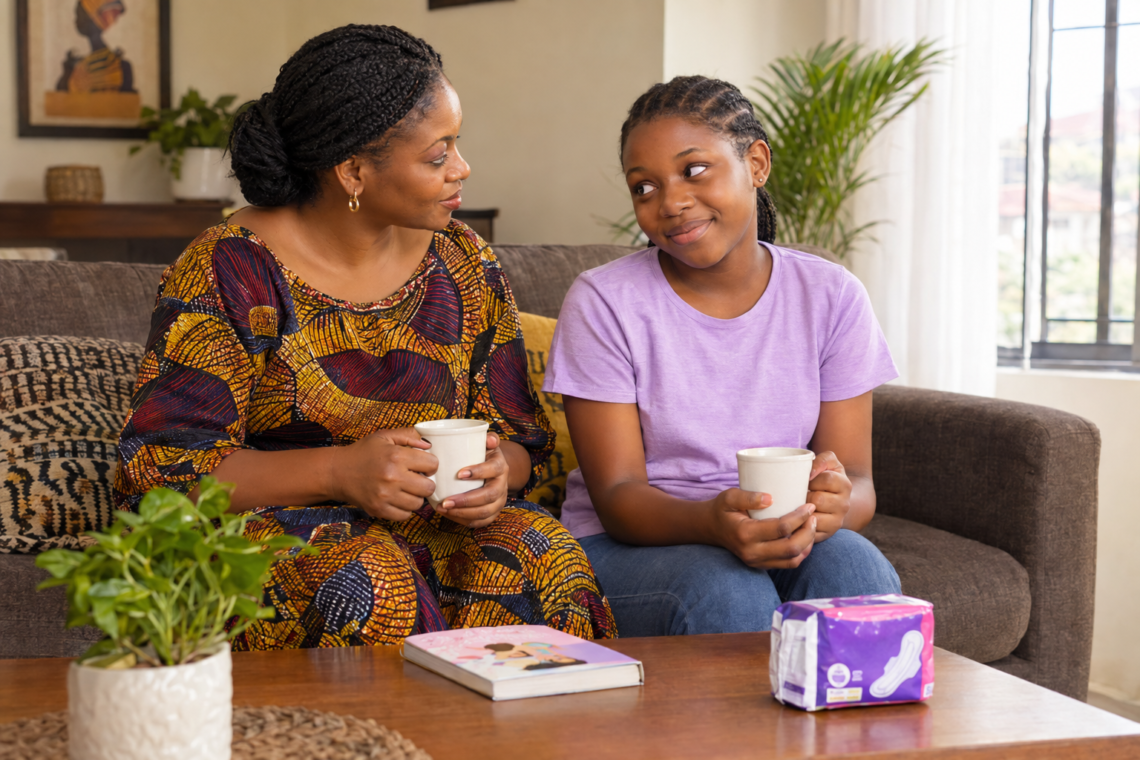
Kemi was eleven years old when she woke up on a Tuesday morning and found blood on her bed sheet. Nobody had ever told her what a period was. She thought she was dying. She was too afraid to tell her mother, because in her house, “those things” were never spoken about. She wrapped her pants in a nylon bag, hid it under her bed and went to school with a stomach ache and a racing heart.

Kemi’s story is an example based on situations that happen in many Nigerian homes. Girls get their first period with no warning. Boys wake up confused and embarrassed. Children learn about their changing bodies from classmates, the internet and rumours, and most of what they hear is wrong.
Meanwhile, parents wait. They say, “She is still small.” They say, “If I tell him, he will go and try it.” They say, “I will talk to her when the time comes.” Then the time comes, and nobody says a word.
This post is for every parent who feels the panic and avoids the subject. You do not need to be an expert. You only need to be willing to speak first. Here is what to say, when to say it, and how to make it easier for everyone in the house.
Why Nigerian Parents Avoid the Puberty Talk
Let us be honest about why this conversation feels so hard. Most of us were never given the talk ourselves. Our parents were uncomfortable, and their parents were uncomfortable too. Silence became a family habit.
Here are the most common reasons parents give for staying quiet:
“It is not proper to speak about these things.” Many families see body talk as shameful. Children quickly learn that the subject is forbidden, so they stop asking questions at home.
“If I explain it, she will try it.” This is one of the biggest beliefs. Research from many countries shows the opposite. Children who receive honest information from parents tend to start sexual activity later and make safer choices.
“The school will teach them.” Some schools teach very little about puberty, and some skip the subject completely. Even when a teacher does cover it, one lesson cannot replace a loving talk at home.
“My child is too young.” Puberty can begin earlier than most parents expect. Girls can start showing signs from around age eight or nine. Boys can start from around nine or ten. If you wait until you see the signs, you may already be late.
“I do not know what to say.” This is the honest reason behind most of the others. Good news: you do not need perfect words. A calm voice and a willing heart are enough.
What Puberty Actually Is
Puberty is the stage when a child’s body grows into an adult body. Hormones, the body’s chemical messengers, start telling the body to change. It is normal, healthy and unavoidable. It does not mean a child is being “fast” or “disrespectful.” It simply means they are growing.
Puberty usually lasts several years. It affects the body, the feelings and the way a child thinks about friends, family and themselves. Every child moves at a different speed, so a child who develops early or late is not a cause for panic.
Signs of Puberty in Girls
Most girls begin puberty between the ages of 8 and 13. The first period often comes around 12 or 13, but it can come earlier or later. Here is what to look out for:
- Small, tender lumps under the nipples, which are the first signs of breast growth
- A quick growth spurt in height
- Hair under the arms and in the private area
- Wider hips and body shape changes
- New body odour
- Oily skin and pimples
- Mood swings and sudden shyness
- A clear or whitish vaginal discharge, which is normal
- The first period, usually about two years after the first breast changes
Signs of Puberty in Boys
Boys usually start a little later than girls, between the ages of 9 and 14. The changes can be confusing, and many boys have no one to explain them. Look out for:
- Growth of the testicles and private area
- A quick growth spurt
- Hair under the arms, on the face and in the private area
- A deeper, cracking voice
- Broader shoulders and more muscle
- Strong body odour and sweating
- Pimples and oily skin
- Wet dreams, which means the body releases fluid during sleep
- More erections, sometimes at times the boy does not expect
Wet dreams and erections are normal. A boy who does not know this may feel dirty, sick or guilty. A simple sentence from his father or uncle can take that burden away: “This happens to every boy. There is nothing wrong with you.”
The Big Topics Every Parent Should Cover
You do not need to explain everything in one sitting. Spread the topics across many small talks. Here are the main ones.
Periods: Tell Her Before It Happens
Every girl should know about periods before her first one. Say it early, around age eight or nine, and then repeat it as she grows.
Explain these basics in simple words:
- A period is blood that leaves the body through the private area, about once a month. It is a sign that her body is healthy.
- A period usually lasts three to seven days.
- It is normal for early periods to be irregular.
- She can use a pad, and you will show her how to wear it and when to change it, usually every four to six hours.
- She can still bathe, go to school, play and cook during her period. The old belief that a girl on her period is unclean or cannot touch food is false.
- Mild cramps are common. A warm compress, a warm drink and rest often help.
Prepare a small period kit and keep it in her school bag. Put in two or three pads, a spare pair of pants, a small nylon bag and a packet of wet wipes. Show it to her and tell her where it is. This one small step can save a girl from fear and embarrassment at school.
See a doctor if she has very heavy bleeding, pain so severe that she cannot go about her day, periods that have not started by age 15, or periods that suddenly stop after being regular.
Body Changes and Hygiene
Children need clear instructions on how to take care of their changing bodies. Do not leave them to guess.
For girls: Bathe daily and wash the private area with clean water and mild soap on the outside only. Do not wash inside the vagina. Wear clean cotton underwear. Change pads regularly. Choose a deodorant suited to young skin once body odour starts.
For boys: Bathe daily. Wash under the arms and in the private area carefully. Clean under the foreskin gently if he is uncircumcised. Change underwear daily. Show him how to wash his face and treat pimples. Show him how to shave when the time comes.
For both: Wash hands often. Brush teeth twice a day. Wash clothes after sweating. Talk about pimples and tell them not to squeeze them, because that leaves scars.
Body Safety and Consent
This is the part many parents skip, and it is the most important. Children who understand their bodies are better able to protect themselves.
Teach these simple rules from an early age:
- Your body belongs to you.
- Some body parts are private. No one has the right to touch them or ask you to touch theirs, except a parent or doctor for health care, and only when a parent is present.
- You can say no to any touch that makes you uncomfortable, even from someone you know, and even from an adult.
- Secrets about touching are never okay. If someone says “do not tell your mother,” tell her anyway.
- You will never be in trouble for telling me, even if someone threatened you.
Many parents imagine that danger comes from strangers. In reality, most children who are harmed are harmed by someone they know, such as a relative, neighbour, teacher, driver, house help or family friend. This is hard to hear, but it is why open talk matters.
Signs that a child may be in trouble include sudden fear of a certain person or place, sleep problems, bedwetting after a long dry period, withdrawal, new fear of being touched, unexplained pain or bleeding, and knowing things about sex that are too grown up for their age. If you notice these signs, stay calm, believe your child, and seek help from a doctor and a trusted organisation. Never blame the child.
Pregnancy, Infections and Staying Safe
This topic is hard for many Nigerian parents, but it must be addressed as children approach their teens. Silence does not protect children. It leaves them with rumours.
Tell your child in simple terms that:
- A girl can get pregnant once she has started having periods, and sometimes even before her first period is noticed.
- Sex has serious emotional and physical consequences, including pregnancy and infections.
- The best choice for a young person is to wait until they are mature and ready.
- No one should ever pressure them. Anyone who truly cares about them will respect their no.
- They can always come to you for help, whatever has happened.
Share your family and faith values with them clearly. You can hold strong values and still give accurate information. The two go together.
Phones, Social Media and Adult Content
Today’s children are exposed to a lot, very early. A child with a phone can stumble on adult videos and images by accident, long before you have spoken to them.
Tell your child that they may come across things online that are confusing or upsetting. Let them know it is not their fault and they will not be punished for telling you. Set up parental controls, keep devices in shared spaces at night, and agree on simple screen rules. Most of all, stay curious about their online life instead of only checking up.
How to Start the Conversation
Many parents fail not because they do not care, but because they do not know how to begin. Here are some tips that make it easier.
Start early and keep it short. Talks of five or ten minutes, repeated many times, work better than one big serious lecture.
Use real moments. Use a TV scene, a pad advert, a pregnant neighbour, a school story or a news report as a doorway. You can say, “I was thinking about something. Can I tell you about it?”
Use correct words. Use the proper names of body parts. This helps children describe a problem clearly if they ever need to.
Choose a relaxed place. Many people find it easier to talk while driving, cooking, walking or doing chores together, because there is no eye contact pressure.
Stay calm. If your child asks something shocking, take a breath. Say, “That is a good question. Let me answer it properly.” Panic teaches a child never to ask again.
Say it is okay not to know. If you do not have an answer, say, “Let me find out, and we will talk again.” Then do it.
Mothers talk to daughters, fathers talk to sons, but not only. Fathers also have a role in explaining periods to daughters. Mothers also have a role in explaining changes to sons. Single parents, grandparents and guardians can take the lead too. What matters is that someone speaks.
Simple Sentences You Can Use Today
If your mind goes blank, borrow from this list:
- “Your body is going to start changing soon. It is normal, and I want you to know what to expect.”
- “When you see blood on your pants one day, do not be afraid. That is a period. Let me show you what to do.”
- “If you wake up with wet clothes at night, it is normal. It happens to every boy as he grows.”
- “You can ask me anything. I will not be angry.”
- “If anyone touches you in a way that feels wrong, tell me straight away. You are never in trouble.”
- “I love you, and nothing you tell me will change that.”
Myths That Hurt Our Children
Let us clear up a few popular myths:
Myth: Talking about puberty makes children want to try sex. Truth: Children who get honest information from parents tend to delay it and make safer choices.
Myth: A girl who has her period can no longer play, cook or enter the kitchen. Truth: A period is a normal body process. She can do all her usual activities.
Myth: Wet dreams are a sign that a boy has been sinful or is sick. Truth: It is a natural body process, and it happens to almost every boy.
Remember It with SAFE
This is a simple guide you can keep in your head.
S: Start early. Begin the talks before the changes arrive.
A: Answer honestly. Use simple words and give true answers.
F: Faith and family values included. Share what you believe while also giving clear health facts.
E: Every talk counts. Keep going. Small repeated talks beat one big one.
Frequently Asked Questions
At what age should I start talking to my child about puberty? Begin simple talks around age 7 or 8, and add more detail as your child grows. If you see early signs of puberty, talk right away.
What if my child already knows everything from friends? Friends often share half truths. Say, “I am happy you are curious. Let me tell you what is true.” Correct the myths gently.
What if I feel too embarrassed? That is normal. You can start by saying, “This is a little awkward for me, but it is important, so I am going to try.” Your child will respect your honesty.
Is it normal for a girl to start her period at 10? It can be, but see a doctor if she shows signs of puberty before age eight or has a period before age ten, to check that everything is fine.
A Final Word to Nigerian Parents
Your child will learn about their body whether you speak or not. The only question is who will do the teaching: you, with love and truth, or friends, strangers and the internet, with half truths and sometimes danger.
You do not have to get it perfect. You only have to begin. This week, pick one small topic, choose a calm moment and say one honest sentence. Then say another sentence next week.
A child who can talk to a parent is a child who stays safer. Be that parent.
If this post helped you, share it with another parent, a teacher or a young mother preparing for the years ahead. Leave a comment below and tell us how you started the conversation in your home. Your story could give someone else the courage to begin.
This article is for general information and does not replace advice from a doctor. If you are worried about your child’s health or development, please speak to a qualified health professional.


