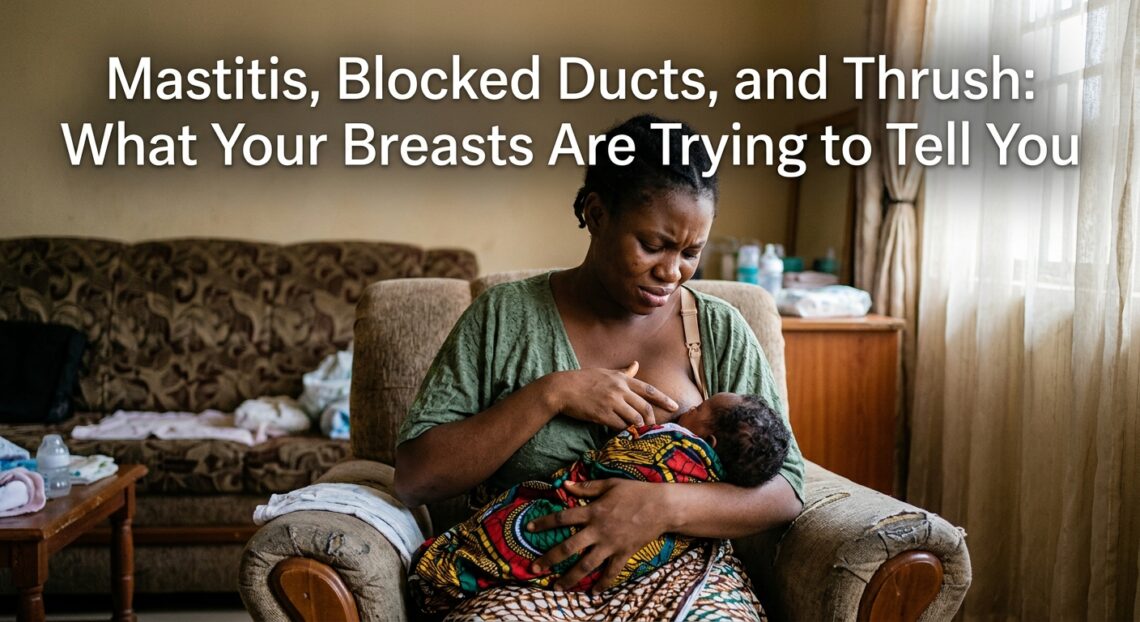

You woke up at 4 AM with a pain in your left breast that took your breath away.
Not the normal soreness of breastfeeding. This is different. Sharp. Burning. Your breast is hot to the touch. You have a fever. You feel like you have the flu, but you do not have the flu. Your baby is nursing fine. Everything else is fine. But your breast is sending a very clear message that something is wrong.
You call your mother-in-law at dawn. She tells you to apply hot water. You call your girlfriend. She tells you to massage it. You call your doctor. The line is busy.
So you do what Nigerian women do. You suffer. You feed the baby anyway because stopping will make it worse. You apply hot water. You massage it. You take paracetamol. You pray. By evening, you feel like you might die. By the next day, you are convinced you definitely will.
Your breasts are trying to tell you something. And you need to understand what it is.
What Your Breasts Do When You Are Breastfeeding
Before we talk about what goes wrong, you need to understand what is supposed to happen.
When you are breastfeeding, your breasts produce milk on demand. When your baby feeds, it empties the milk. The breast signals back to your body: milk was removed, make more. When the baby does not feed from one side, the milk stays in that breast until it is removed. The breast gets full. If the milk is not removed regularly, it backs up. The tissue becomes engorged. The pressure builds.
This is all normal. Your body is managing supply and demand. But your breasts need the milk to keep moving. Stagnant milk creates problems.
Blocked Ducts: The First Warning Sign
A blocked duct is exactly what it sounds like. One of the small tubes that carries milk from the milk-producing tissue to the nipple is blocked. Milk is backing up behind that blockage. The area feels like a hard lump. It might hurt. It might be tender to touch. But you do not have a fever. You do not feel sick. You just have a lump.
A blocked duct is your breast’s way of saying, “Please move this milk.”
What Causes a Blocked Duct
Milk is not being removed frequently enough from that area of the breast. This can happen if your baby is feeding from only one position and not emptying all parts of the breast. It can happen if your bra is too tight and pressure is cutting off flow. It can happen if you have been going longer than usual between feeds. It can happen if you are stressed or dehydrated, which affects milk production and flow.
Sometimes there is no clear reason. It just happens.
What Actually Helps a Blocked Duct
Frequent feeding from that breast. Offer the affected breast first, when your baby is hungriest and sucks hardest. The baby’s strong suck can often dislodge the blockage. Feed as often as you can, at least eight to twelve times per day if possible.
Different feeding positions. The baby’s chin should point toward the blocked area. If the blockage is toward the underside of your breast, use a position where the baby is below the breast (like football hold). If the blockage is toward the top, use a position where the baby is above. Different angles of suction can help clear different areas.
Warm compress before feeding. Warmth helps milk flow. A warm (not hot) cloth on the breast before feeding can help loosen the blockage. Do this for a few minutes, then feed.
Gentle massage. This is different from aggressive massage. You are not trying to force the blockage out. You are gently encouraging milk to move toward the nipple. Use your fingers to gently massage from the area of the blockage toward the nipple, stroking in that direction. Do this before and during feeding. The pressure should be gentle enough that it does not hurt more.
Heat after feeding, then cold. Some mothers find that heat before feeding helps flow, then cold after feeding reduces inflammation. A warm compress or warm water before, then ice or a cold cloth after. This cycle can help.
Movement and rest. Gentle movement helps circulation. But so does rest. You are not supposed to be doing heavy exercise when you have a blocked duct. Your body needs energy to clear the blockage, not to power through workouts.
Hydration and nutrition. Drink water. Eat well. Your body is producing milk, so it needs fuel and fluid. Many blocked ducts resolve when mothers finally drink enough water and eat enough food.
What does NOT help: Aggressive massage, ice before feeding (this constricts milk flow), or stopping breastfeeding. Stopping breastfeeding makes blocked ducts worse, not better. The milk keeps backing up.
When a Blocked Duct Becomes Mastitis
A blocked duct usually resolves in twelve to forty-eight hours with the strategies above. If it does not clear, if the pain increases, if you develop a fever, you have progressed from a blocked duct to mastitis.
Mastitis: When Infection Takes Over
Mastitis happens when milk backs up so long that it becomes infected. The blocked duct never cleared, so bacteria from your skin or baby’s mouth entered the backed-up milk, and now you have an infection in your breast.
Mastitis feels like the flu. You have a fever, usually 101 degrees Fahrenheit or higher. You have body aches. You feel exhausted and achy. And your breast is red, swollen, hot, and extremely painful.
This is not something to push through. This is not something that will go away with more hot water. This requires treatment.
What Causes Mastitis
Milk not moving because of a blocked duct. Infrequent feeding. Engorgement. Stress. Dehydration. Cracked nipples that let bacteria in. Sometimes there is no clear cause. It just happens.
What You Need to Do About Mastitis
First: see a doctor. Mastitis is an infection. You need medical assessment and likely antibiotics.
Many Nigerian mothers try to avoid antibiotics. They think antibiotics will hurt the baby or affect milk supply. This is not true. Antibiotics that are safe for breastfeeding exist. Your doctor can prescribe one that you can safely take while nursing.
If you do not treat mastitis with antibiotics, it can progress to a breast abscess, which is a pocket of pus in the breast. A breast abscess requires surgical drainage. It is painful and complicated. Antibiotics are much simpler.
Take the antibiotics exactly as prescribed. Do not stop after a few days because you feel better. Do all of them. If your symptoms do not improve after two to three days of antibiotics, see your doctor again. You might need a different antibiotic or there might be a complication.
While you are taking antibiotics, continue doing everything else:
Frequent feeding from both breasts. The affected breast might be more painful, but feeding actually helps clear the infection. Your baby will not get the infection from nursing. Your antibodies in the milk are protecting your baby.
Warm compresses and gentle massage before feeding.
Cold compresses after feeding to reduce inflammation.
Over-the-counter pain medication. Paracetamol and ibuprofen are both safe while breastfeeding and while taking antibiotics. Take them regularly to manage pain.
Rest and fluids. Your body is fighting an infection. It needs rest and water.
When Mastitis Is Really Bad
Call a doctor immediately if:
You have a very high fever (over 102 degrees Fahrenheit). This could indicate a developing abscess or sepsis.
You have a hard lump that is not getting better after two days of antibiotics. This might be an abscess forming.
You have pus or blood coming from your nipple. This is unusual and needs evaluation.
You have red streaks running from your breast toward your armpit. This could indicate lymphangitis, an infection in the lymphatic system.
You start feeling confused, very dizzy, or unable to stay awake. This could indicate sepsis.
Do not wait for these to resolve on their own. Get medical care.
Thrush: The Fungal Infection Nobody Expects
Thrush is a yeast infection. Candida albicans, a fungus that lives on everyone’s skin in small amounts, takes over. For your baby, this means white patches inside the mouth. For you, it means pain that feels different from other breast pain.
Thrush pain is often described as burning. Sharp. Shooting. It can feel like fire inside your breast. The pain can continue even when your baby is not feeding. You might have it in one breast or both. Your nipples might look red or shiny. You might feel itchy. You might have other signs of yeast infection on your body.
What Causes Thrush
An antibiotic you took recently. Antibiotics kill bacteria but they can also kill the good bacteria that normally keep yeast in check. After antibiotics, yeast can overgrow.
Warm, moist environment. Your breasts are warm and moist during breastfeeding. Yeast loves this.
Stress or low immunity. When your immune system is down, yeast takes the opportunity to grow.
Cracked nipples. Damaged skin is more susceptible to yeast infection.
Thrush in your baby’s mouth. If your baby has oral thrush, your baby can pass it to your breast. If you have thrush on your breast, you can pass it to your baby’s mouth. It is a cycle that you both need to break.
What You Need to Do About Thrush
See a doctor for confirmation. The symptoms of thrush can overlap with other breast pain, so you want a professional to confirm that it is actually thrush before treating it.
Antifungal treatment for you. Your doctor might prescribe a cream to apply to your nipples, or oral medication, or both. These are safe while breastfeeding. Use exactly as prescribed. Thrush is stubborn and will come back if you stop treatment too early.
Antifungal treatment for your baby. If your baby has thrush in the mouth, your baby needs treatment too. The baby might need oral drops or a gel. Treat your baby exactly as prescribed.
Treatment for any cracked nipples. Heal the damage so thrush has nowhere to hide.
Cultural Remedies for Thrush (and What Actually Works)
Some grandmothers recommend applying shea butter, palm oil, or honey to the breast. These are warm, soothing, and have some antimicrobial properties. They might provide comfort. But they are not going to cure thrush. Thrush requires antifungal medication, not oils.
Some recommend avoiding certain foods. There is a theory that sugar feeds yeast and you should avoid it. This is not well-supported for treating thrush in breastfeeding. You do not need to eliminate sugar from your diet to treat thrush. You need antifungal medication.
Some recommend probiotics or probiotic foods. Probiotics might help prevent thrush from coming back, but they are not going to treat active thrush. Again, you need antifungal medication first.
The cultural remedies are not harmful, but they are not sufficient. Use them for comfort if you want to, but understand that you also need medical treatment.
The Three Conditions: How to Tell Them Apart
This is the part where knowing the difference matters, because treatment is different for each one.
Blocked Duct:
- Hard lump in breast
- No fever
- No systemic illness
- Pain localized to that area
- Can resolve with home care in 12-48 hours
- Antibiotics not needed
Mastitis:
- Redness, swelling, heat in breast area
- High fever (101°F or higher)
- Feels like the flu: body aches, fatigue, chills
- Usually needs antibiotics
- Can develop from a blocked duct if left untreated
- Starts quickly
Thrush:
- Burning pain that continues even between feeds
- Possibly white patches in baby’s mouth
- Possibly red, shiny, or cracked nipples
- No fever (unless there is a secondary bacterial infection)
- Requires antifungal treatment
- Might follow antibiotic use
- Develops gradually
What Actually Works in Nigerian Context
Here is what Nigerian mothers know that is actually helpful:
Hot water. Applied before feeding, it genuinely helps with milk flow. Just make sure the water is warm enough to help but not so hot that it burns. Test temperature with your hand first.
Frequent feeding. Feeding often, from different positions, is the foundation of clearing ducts and managing engorgement. This works across all three conditions.
Rest and fluids. Your body is healing or fighting infection. It needs these. Many Nigerian mothers push through and delay recovery. Rest actually speeds things up.
Support from another woman. Having someone there who has been through this, who can sit with you, bring you water, help you position the baby, and tell you this will pass — this matters. Do not underestimate the power of this support.
Knowing when to get professional help. This is the part that matters most. You can manage blocked ducts at home. You cannot manage mastitis or thrush at home. You need antibiotics or antifungals. Getting this help is not weakness. It is sense.
Prevention: So You Do Not Have to Deal With This
The best approach is not having these problems in the first place.
Feed frequently. Eight to twelve times per day in the early weeks. This keeps milk moving.
Vary positions. Different positions empty different parts of the breast. Switch positions at each feeding.
Ensure proper latch. A good latch is the foundation of pain-free breastfeeding and good milk flow. If latching is painful, get help from a lactation consultant or experienced breastfeeding mother.
Avoid tight bras or anything that puts pressure on your breasts. Pressure restricts milk flow. Wear loose, comfortable bras or no bra at all at home.
Stay hydrated. Drink water throughout the day. Many blocked ducts and engorgement issues improve with more water.
Manage stress. Stress affects milk flow. Find ways to rest and relax, especially in the early weeks.
Avoid unnecessary antibiotics. Only take antibiotics when they are truly needed. Overuse increases risk of thrush later.
Watch your baby’s latch and feeding. If something does not feel right, get help early. Early intervention prevents problems from getting worse.
The Reality of Breastfeeding
Breastfeeding is natural, but it is not always easy. Your breasts might hurt. Things might go wrong. Blocked ducts happen to most breastfeeding mothers at some point. Mastitis happens to many. Thrush happens to some.
None of this means you are doing it wrong. None of this means you should stop breastfeeding. It means your body is learning to produce milk, your baby is learning to feed, and sometimes the process has complications.
The difference between suffering for weeks and resolving it quickly is knowing what is happening and getting the right help. And that starts with understanding what your breasts are trying to tell you.
If you are dealing with breast pain right now, please see a doctor. Do not wait. Do not assume it will go away. Do not just apply hot water and hope. Your breasts need proper care. And you deserve to breastfeed without this level of pain.
If you have dealt with mastitis or thrush and came out the other side, share your story in the comments. So many mothers are suffering silently thinking they are alone.